🎯 Two rooms, two grounds: the voltage between them rides the ch 2 and 20 pairs into the Trident
- noise current
- clean pair
- ✕taken out: buzz gone
- ✓changed: buzz stayed
- ~changed the level
💡 Lights raise it. They are not the only source
🧪 22 parts tested, 13 never tested, and most of the building is grey
- ✓ clean
- ✕ still buzzes
- ▼ pull it: silent
- ? never tested
🎛️ Mix room
- Wall panel✓
- Mic cable✓
- Mix Catapult✓
- DPA snake✓
- Trident strip✓
- Trident power?
- Pro Tools, Antelope?
- Headphones?
🧵 Between the rooms
- Original Cat6▼
- New Cat6✕
- Cat6 route?
🗄️ Mic closet
- Closet Catapult to QSC✕
- Ground lift✕
- Ch 2 XLR▼
- New XLR✕
- Source direct into GX✓
- Other GX inputs out✕
- GX aux outs✕
- GX power off✕
- SLink out✕
- SQ-7 off✕
- QSC on A&H channel✕
- Body near rack✕
⚙️ Settings
- No mic plugged✕
- Phantom off, ch 2?
- Gain change, ch 20✕
🏢 Building
- Lights off✕
- Chassis voltage?
- Outlets, circuit?
- All mains off?
- Modem?
- Lorex cameras?
- Lighting PoE switch?
- HVAC?
- Dante, other network?
📋 Full test matrix, with test IDs
| Component | Ch 2 | Ch 20 | Control ch 1 / 16 |
|---|---|---|---|
| Microphone present (SM57) | ✕ Buzz with no mic (P8) | ✕ Buzz with no mic (P8, inferred) | · NT |
| Mic cable (Mogami) into panel / Catapult | ✓ Clean to Trident (P4) | · NT | · NT |
| Live Room wall panel / tie lines | ✓ Clean to Trident and QSC (P5, P6) | · NT | · NT |
| Mix-room Catapult | ✓ Clean to Trident (P4, P5), clean to QSC (P14) | · NT | · NT |
| DPA snake, Catapult to Trident (two snakes) | ✓ Clean (P3) | · NT | · NT |
| Trident channel strip | ✓ Clean via mix-room path (P1, P3 to P5) | · NT | · NT |
| Trident power | · Never turned off | · Never turned off | · Never turned off |
| Original Cat6, mix-room to mic-closet Catapult | ▼ Gone when pulled (P9, T2, T24). Port swap unclear (T15). Pins all green (T18) | ▼ Gone when pulled (T10, T24) | · NT |
| Replacement Cat6 run (silver) | ✕ Buzz stays (T30, T31). Gone when pulled (T32) | · NT | ✓ Ch 1 clean (T30) |
| Mic-closet Catapult straight to QSC, line level | ✕ Buzz (P15) | · NT | · NT |
| Mic-closet Catapult ground lift pushed in | ✕ No change (P10) | · NT separately | · NT |
| XLR patch, Catapult to GX input | ▼ Gone when pulled (T2/T3, T11), back when replugged (T12). Swapped cable still buzzes (T8) | ▼ Faint buzz left when pulled at either end (T24) | · NT |
| GX4816 input fed direct, Catapult bypassed | ✓ Clean (P7, T28) | · NT | · NT |
| GX4816 inputs 1, 3 to 8 unplugged | ✕ No change (T19) | - n/a | - n/a |
| GX4816 aux outputs (PA, IEM, monitors) unplugged | ✕ Changed, never gone, inconsistent (T9) | · NT | · NT |
| GX4816 power off | ✕ Buzz stays (T6, T13, T19) | · NT | · NT |
| SLink, GX to SQ-7, pulled | ✕ Buzz stays (T13, T25). T4 unclear | · NT | · NT |
| SQ-7 power off | ✕ Buzz stays (T5, T20) | · NT | · NT |
| QSC speaker direct on A&H channel | ✕ Buzz (P13) | · NT | · NT |
| Phantom power off on ch 2 | ? Result not stated (T26) | · NT | · NT |
| Gain change | · NT | ✕ No change (T27) | · NT |
| Touch / body position near the rack | ✕ Touch no change (T14). Worse with body near (T21) | · NT | · NT |
| Catapult power | - Passive per vendor; staff said PoE | - Same | - Same |
| Catapult bank / route | ✕ Shares a route with clean ch 1 (P12) | ✕ Shares a route with clean ch 16 (P12) | ✓ 1 and 16 clean (P12) |
| Cat6 physical route (under mix room, ceiling) | · NT | · NT | · NT |
| Room / outlet / circuit | · NT | · NT | · NT |
| Mains all-off test | · Planned (T33), not run | · NT | · NT |
| Lighting / dimmers | · NT | · NT | · NT |
| HVAC | · NT | · NT | · NT |
| Dante / other network | · NT | · NT | · NT |
| DAW / Antelope converters | · NT | · NT | · NT |
| Headphones | · NT | · NT | · NT |
| Hiss (second sound) | - Present apart from the buzz (T11) | · NT | · NT |
🔎 Something on 2 and 20 turns the voltage into buzz: phantom leads, the GX trails
📈 Top 10 table, with the driver and paths
| # | ID | Hypothesis | Role | Confidence |
|---|---|---|---|---|
| 1 | A1 + A2 | Floating ground potential between the two racks (open IG ground, chassis held by Y-caps) | Driver | High that it exists and contributes; moderate that it is the main driver |
| 2 | C1 | Trident phantom on for 2 / 20 and off for 1 / 16 | Converter | Moderate-low; turns on one unrecorded fact |
| 3 | B12 | Hand-wired screw-terminal terminations on 2 / 20 (Oct 2024 install) | Converter | Low-moderate; terminal location unrecorded |
| 4 | B2 | Mic-closet Catapult position 2 / 20, including its RJ45 jack | Converter | Low-moderate |
| 5 | B3 | Mix-room Catapult position 2 / 20, including its RJ45 jack | Converter | Low-moderate |
| 6 | B4 | Trident input 2 / 20 imbalance | Converter | Low-moderate |
| 7 | A19 / A12 / A11 / A13 | Lighting current or lighting-transformer reference on the grounding system | Lights-dependent share of the driver | Moderate that lighting contributes; low on any one mechanism |
| 8 | A17 | Hear Back hub and NAS on the lighting PoE switch bond the mix-room rack to the lighting ground | Path for the lights share | Low-moderate |
| 9 | B1 | GX input 2 / 20 passive network asymmetry | Converter | Low |
| 10 | A8 / A9 | GX aux-output loads (subs, Furman amp, PSM900s) hold the GX chassis potential | Path | Moderate as a path, low as a cause |
🔊 Loudness check: a 1% phantom-resistor mismatch with 1 V between grounds gives about -83 dBu at the input, easily audible after preamp gain. Nobody has measured the chassis-to-chassis voltage yet (tree step 3).
🌳 Test tree: 14 steps, each ends in a named cause
- 🔇 Mute the monitors before switching phantom or plugging XLRs
- ⛔ Never lift a mains safety ground
- ⚡ Any reading above 30 V AC with 10 kΩ across the leads: stop, call an electrician
📋 Send me this: 12 items, tick as you go
Ticks stay on this phone. Items 2, 8 and 10 alone cut 48 hypotheses to about five.
📏 Each step in words: what to measure, how to read it
0Baseline⏱️ 3 min
📏 Measure: Buzz audible, lights on. Record 20 s of Trident ch 2 and ch 1 into Pro Tools; gain and fader untouched all session. Note peak level
➜ Read: Every later better / worse is read off this
1Phantom audit⏱️ 5 min
📏 Measure: Photograph phantom on 1, 2, 16, 20 (Trident, SQ-7 page, GX LEDs). SQ-7 phantom off for 2 / 20: a lit GX PP LED proves Trident phantom arrives through the split. Then all phantom off on the four channels, wait 30 s, record
➜ Read: Gone = branch C (C1, C3, C4). Unchanged = C1 to C4 dead; leave phantom off
2Battery recorder at the far end⏱️ 5 min
📏 Measure: Catapult out 2 from GX input 2 into a battery recorder, phantom off, nothing else plugged in, hands off. Listen on Trident ch 2
➜ Read: Gone = ground loop confirmed, pickup dead. Stays = the pair picks it up: rerun a spare Cat6 on a different route
3Meter the grounds, lights on and off⏱️ 10 min
📏 Measure: AC V GX chassis to Trident chassis, meter alone then with 10 kΩ across the leads. AC V outlet ground pin to cold-water pipe or service panel. AC V N-G at the GX and Trident PSU outlets
➜ Read: Under 50 mV chassis-to-chassis = too small. Collapses under 10 kΩ = high-impedance float. Holds and rises with lights = load current on ground. Outlet ground over 1 V from the pipe = open IG confirmed
4Temporary 12 AWG bond⏱️ 3 min
📏 Measure: Clip 12 AWG from GX chassis to Trident chassis, listen, record. Repeat the body-position check
➜ Read: Sharp drop = driver confirmed, safe interim. Unchanged = move the clip to the Catapult rack, then the Furman rack
5Clear the wall panel⏱️ 2 min
📏 Measure: Unplug tie line 2 from the mix-room Catapult input
➜ Read: Unchanged = B7 dead
5bLeg-balance ohms⏱️ 10 min
📏 Measure: Power off. Ohms pin 2 to pin 1 and pin 3 to pin 1 on hand-wired 2, 20 and control 1; end-to-end pin 2 vs pin 3. GX inputs 1, 2, 16, 20 off and empty: legs match within about 1%. Same at Trident 2 and 20
➜ Read: Anything but open (OL) = a leak. A leg off its partner = the part
6Locate the converter⏱️ 3 × under 10 min
📏 Measure: 6a: QSC in place of the Trident ch 2 feed. 6b: Catapult out 2 into GX in 1, out 1 into GX in 2. 6c: mic-closet Cat6 bank 1-4 into the 5-8 jack, XLR 6 into GX in 2
➜ Read: 6a buzz = Trident not needed. 6b buzz moves to ch 1 = GX input 2. 6c gone = mic-closet position 2 hardware
7Strip the GX grounds⏱️ 5 min
📏 Measure: Mute PA. Unplug all 16 GX output XLRs, then the GX IEC cord
➜ Read: Gone with outputs out = aux loads are the GX end of the loop
8Hunt the residual, lights off⏱️ 10 min
📏 Measure: 60 s each, recorded: Hear Back and NAS cables at the lighting PoE switch; Mix Room Lorex camera Ethernet, then NVR; other Ethernet into the mic-closet rack; audio into the PTZ camera; ISP cable and any coax; HVAC off; PSM900s off
➜ Read: The one that drops the residual is the second driver
9SQ-7 network⏱️ 1 min
📏 Measure: Pull the SQ-7 network cable (on the lighting PoE switch in 2025)
➜ Read: Expected no change; leave it out until the SQ-7 has its own switch
10Transformer isolation on ch 2⏱️ 5 min
📏 Measure: 1:1 mic-level iso transformer between Catapult out 2 and GX in 2 (a passive DI backwards, lift engaged, is a crude stand-in)
➜ Read: Gone = common-mode mechanism confirmed and the RX4M fix proven
🔧 The fix: transformers on the closet leg, grounds bonded to service
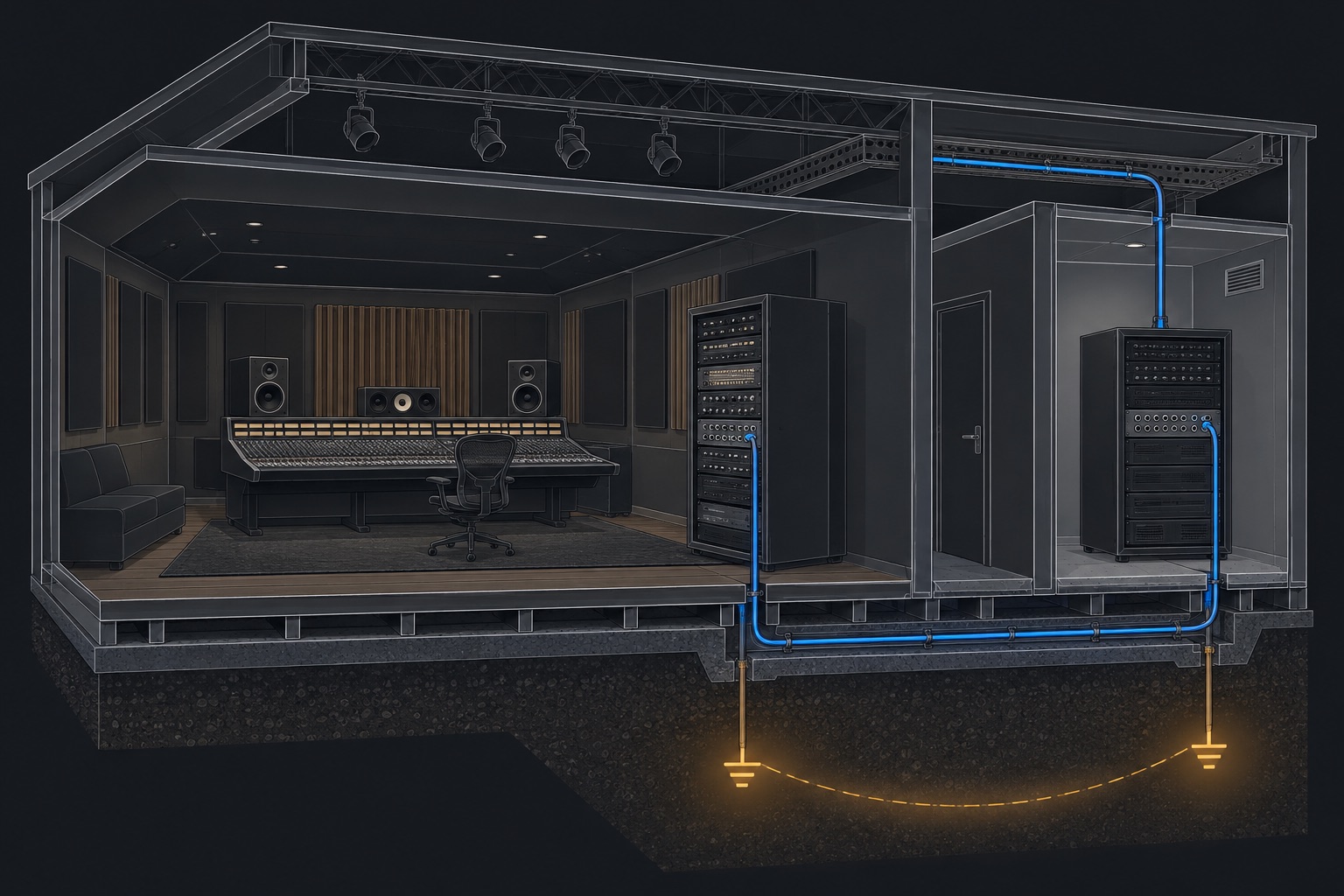
🔧 RX4M transformer modules on the mic-closet leg end the loop for every channel. In parallel, the electrician bonds the IG bus and the lighting transformer's secondary to the service ground.
📅 The same two-channel shape since the first week of the install
🔁 What changed since v1 (9 items)
- 🔁 A&H GX input fault drops to rank 9: it needs two separate faults, and the bad channels move over time 05 §5
- 🔁 Trident phantom on for 2 / 20 is now rank 2, a 30-second test 05 §5
- 🔁 Hand-wired screw terminals from the Oct 2024 install enter at rank 3 (Thai: “Snip, strip to bare wire, insert into connector and screw down”) 07 chat.db 1321
- 🔁 The two-channel buzz dates to Oct 2024, on channels 9 and 10, one week after install 07 chat.db 71841
- 🔁 Internet is Frontier fiber, which carries no shield: the modem / coax loop falls to low unless a coax service is still connected 07 item 11
- 🔁 Ch 16 and ch 20 share a Catapult pair position, so the twist-rate theory is dead 06 §2, 05 B8
- 🔁 Why the bad channels moved (9 and 10 in Oct 2024, then 2, 20, 22 in 2026): a connection wearing at one physical spot, or a phantom setting, fits. Relabeling does not, because the count grew from two to three. Phantom hot-patched through the split can itself damage one input leg, which then stays bad 05 §8.2
- 🔁 Weak pattern, worth one check (low confidence): channels 2, 10 and 22 all sit on the blue 4-5 pair, position 2 of their banks, about a 1-in-10 chance by accident. Ch 20 does not fit 05 §8.2, 06 1.1
- 🔁 Radial specifies TX4M/RX4M transformer modules for a mic split between two mixers; TRC's split is a passive Y 06 1.7
📚 Every buzz and ground complaint since install
- InstallIntermittent buzz since setup; crew pressed ground switches until it worked
- 2024-05-24Inspector: some outlets had no ground
- 2024-09RodCo proposes an isolation transformer for the stage-light distro; never installed
- 2025-08-29Mix Room clients: buzz on different channels, low hum, unusable channels
- 2025-10-23Livestream buzz; Alex: “almost certainly the lights”
- 2025-12-01Lobby speaker buzz after Farzad's crew
- 2026-01-22Every Live Room outlet open ground; QSC sub broken again
- ~2026-03-16Channels 2, 20, 22 down / crossing; Catapult bypass cleared ch 2
- 2026-06-01Omni piano buzz fixed by a DI ground lift
- 2026-06-22Noise on the stage-right snake; ports and cables swapped
- 2026-08-03Handoff: loud buzz with 48 V on Live Room mic lines; high noise floor in all rooms
- 2026-09-04Rehearsal room hum from loose cables; Apollo on the TV's power
- 2026-09-09Greg: Live Room buzz on a few channels; lighting breaker off at night
- 2026-09-12Ch 26 buzz on the Trident
- 2026-09-21Elijah: both mixers clean direct in; the loop appears when both sides are on
- 2026-09-25Ch 2 and 20 buzz; needs the Cat6 link and the ch 2 XLR into the GX
🧪 8 of 48 hypotheses fit all 12 observations, and every one is a per-channel converter (B1, B2, B3, B4, B6, B7, B9, B12)
👉 swipe for all 12 observations
| ID | Hypothesis | O1 | O2 | O3 | O4 | O5 | O6 | O7 | O8 | O9 | O10 | O11 | O12 | Fit | Tie-break | Total |
|---|---|---|---|---|---|---|---|---|---|---|---|---|---|---|---|---|
| A1 | Open IG ground, racks float apart | F | F | F | F | F | F | F | P | F | F | F | F | 11 | +1 (S7) | 12 |
| A2 | Chassis float through EMI filter Y-caps | F | F | F | F | F | F | F | P | F | F | F | F | 11 | +2 (S7, S13) | 13 |
| A3 | ISP entrance ground (Frontier fiber ONT, Cat5e from electrical room to office; cable coax unconfirmed) | F | F | F | F | F | F | F | P | N | N | N | F | 8 | -1 (fiber carries no shield) | 7 |
| A4 | Lorex PoE: Mix Room camera near the sub, NVR in office, relays in electrical closet | F | F | F | F | F | F | F | P | N | N | N | F | 8 | +1 (camera in mix room, [07] item 10) | 9 |
| A5 | Network switch ties SQ-7 network port to the ISP ground | F | F | F | X | F | F | F | P | N | N | N | N | 4 | 0 | 4 |
| A6 | Lighting LED drivers and dimmers leak into the ground system | F | F | F | F | F | F | F | P | N | N | N | F | 8 | 0 | 8 |
| A7 | HVAC compressor or drive | F | F | F | F | F | F | F | P | N | N | N | N | 7 | 0 | 7 |
| A8 | Subs on their own wall outlets tie the GX chassis via its aux out | F | F | F | F | F | F | F | P | F | N | N | N | 8 | 0 | 8 |
| A9 | Furman-fed Crown amp and PSM900s tie the GX chassis via aux outs | F | F | F | F | F | F | F | P | F | N | N | N | 8 | 0 | 8 |
| A10 | Missing-neutral or bootleg-ground circuits (Farzad: "rest of the building is unknown") | F | F | F | F | F | F | F | P | N | N | N | F | 8 | +1 ([07] item 7) | 9 |
| A11 | Neutral-to-ground bond downstream, in the Outdoor / Stage Lights subpanel | F | F | F | F | F | F | F | P | N | N | N | F | 8 | +1 (no neutral there until Nov 2025) | 9 |
| A12 | 3-phase distro on two of three phases: uncancelled neutral current and harmonics | F | F | F | F | F | F | F | P | N | N | N | F | 8 | +1 ([07] item 4) | 9 |
| A13 | Stage-lighting load raises the shared panel's neutral | F | F | F | F | F | F | F | P | N | N | N | F | 8 | +1 (RodCo confirms shared panel) | 9 |
| A14 | Trident PSU Star Ground Link state sets the mix-room reference | F | F | F | F | F | F | F | P | N | N | N | N | 7 | 0 | 7 |
| A15 | SQ-7 network port on the lighting / camera PoE switch | F | F | F | X | F | F | F | P | N | N | N | F | 5 | +1 (documented May 2025) | 6 |
| A16 | GX or other mic-closet gear on the lighting / camera PoE switch through a mic-closet drop | F | F | F | F | F | F | F | P | N | N | N | F | 8 | -1 (drop only proposed) | 7 |
| A17 | Hear Back hub and NAS on the lighting PoE switch bond the mix-room rack to the lighting ground | F | F | F | F | F | F | F | P | N | N | N | F | 8 | +1 ([07] chat.db 17776) | 9 |
| A18 | Console-to-PTZ-camera audio feed (1/4 inch to 1/8 inch, unbalanced) | F | F | F | X | F | F | F | P | N | N | N | F | 5 | 0 (existence unknown) | 5 |
| A19 | Lighting power transformer secondary unbonded, or bonded into the IG / audio ground | F | F | F | F | F | F | F | P | N | N | N | F | 8 | +1 ([07] item 6) | 9 |
| B1 | GX input 2 / 20 passive network asymmetry (phantom resistor, RF cap, clamp) | F | F | F | F | F | F | F | F | F | F | F | F | 12 | -4 (S1, S3, S9 -1 each; two faults -2; S10 +1) | 8 |
| B2 | Mic-closet Catapult position 2 / 20 (solder, XLR contact, corrosion) | F | F | F | F | F | F | F | F | F | F | F | F | 12 | +1 (S1, S3, S5, S10 +1 each; two faults -2; S9 -1) | 13 |
| B3 | Mix-room Catapult position 2 / 20 (split or receive unit) | F | F | F | F | F | F | F | F | F | F | F | F | 12 | +1 (as B2) | 13 |
| B4 | Trident input 2 / 20 imbalance | F | F | F | F | F | F | F | F | F | F | F | F | 12 | 0 (S1, S3, S10 +1; two faults -2; S9 -1) | 12 |
| B5 | Pin-1-to-shell short or pin swap on the XLR patch at the GX | F | F | F | F | X | F | F | F | F | F | F | F | 9 | 0 | 9 |
| B6 | DPA multipin pin fault on 2 / 20 (Trident side) | F | F | F | F | F | F | F | F | F | F | F | F | 12 | 0 (as B4) | 12 |
| B7 | Wall-panel tie-line leg leaking to the grounded panel box or conduit | F | F | F | F | F | F | F | F | F | F | F | F | 12 | 0 (as B4) | 12 |
| B8 | Cat6 pair assignment: 2 and 20 on a looser-twist pair | F | F | F | F | F | F | F | X | N | N | F | F | 7 | -1 (S12: twist-per-colour premise false) | 6 |
| B9 | RJ45 jack contact damage inside a Catapult (high resistance on one leg) | F | F | F | F | F | F | F | F | F | F | F | F | 12 | 0 (as B4) | 12 |
| B10 | Split pair in field termination (floor box, keystone, hand crimp) | F | F | F | F | F | X | F | F | F | N | F | F | 8 | +1 (S11) | 9 |
| B11 | Pin-map mismatch or internal miswire between Catapult units | F | F | F | F | F | F | F | F | F | N | F | F | 11 | -1 (S12: one pin map for all modules) | 10 |
| B12 | Hand-wired screw-terminal terminations on 2 / 20 (leg leaking to shield, loose screw, stray strand) | F | F | F | F | F | F | F | F | F | F | F | F | 12 | +4 (S1, S3, S9, S10, S11 +1 each; several faults -1) | 16 |
| C1 | Trident phantom on for 2 / 20, off for 1 / 16 | F | F | F | F | F | F | F | F | F | N | F | F | 11 | +6 (S1, S3, S4, S6, S9, S13) | 17 |
| C2 | SQ-7 / GX phantom on for 2 / 20 | F | F | X | N | F | F | F | F | F | N | F | F | 7 | +1 (S4) | 8 |
| C3 | Trident phantom back-feeds an unpowered GX input through its clamp diodes | F | F | F | F | F | F | F | F | F | N | F | F | 11 | +1 (S4) | 12 |
| C4 | Trident phantom-rail ripple, drawn out by the GX input load | F | F | F | F | F | F | F | F | F | N | F | N | 10 | +1 (S4) | 11 |
| D1 | Magnetic pickup on the Cat6 route (lighting feeders, LED wall) | F | F | F | F | F | F | F | P | N | X | F | F | 8 | 0 | 8 |
| D2 | Electric-field pickup from lighting cabling | F | X | F | F | F | F | F | P | N | F | N | F | 7 | 0 | 7 |
| D3 | Cat6 unshielded or shield open, so no pin-1 bond between rooms | F | F | F | F | F | F | F | P | F | F | F | F | 11 | 0 | 11 |
| D4 | A high-impedance floating node on the ch 2 path (body effect) | F | F | F | F | F | F | F | P | F | F | F | F | 11 | 0 | 11 |
| D5 | RF demodulation (PSM900, Wi-Fi, cellular) at an imbalanced input | F | F | N | F | F | F | F | P | F | F | N | N | 8 | 0 | 8 |
| D6 | Shield-current-induced noise in foil-and-drain STP | F | X | F | F | F | F | F | N | F | N | X | F | 4 | 0 | 4 |
| E1 | GX4816 active input-board fault | F | F | X | F | F | F | X | F | F | F | N | N | 4 | -1 (S3) | 3 |
| E2 | SQ-7 fault | F | F | X | X | F | F | X | F | N | N | N | N | -1 | 0 | -1 |
| E3 | Whole Catapult unit fault (all channels of a bank) | F | F | F | F | F | F | F | X | F | N | N | F | 7 | 0 | 7 |
| F1 | Channel numbering or label mismatch; unrecorded channels in P13, P15, T15 | n/a: not scored | n/a | n/a | ||||||||||||
| F2 | Bank-level cause (cable, shield, lift, RJ45 as a whole) | F | F | F | F | F | X | F | X | N | N | X | F | 1 | 0 | 1 |
| F3 | "16 and 20 same route" means same 12-channel unit, not same bank | n/a: not scored | n/a | n/a | ||||||||||||
| F4 | Listening-method artifact (iPhone Live Listen by ear; "decreased" unquantified) | n/a: not scored | n/a | n/a | ||||||||||||
O1 to O12 are the 12 key observations; O12 is the lights-off test. Score: F +1, N and P 0, X -2, plus tie-breaks.
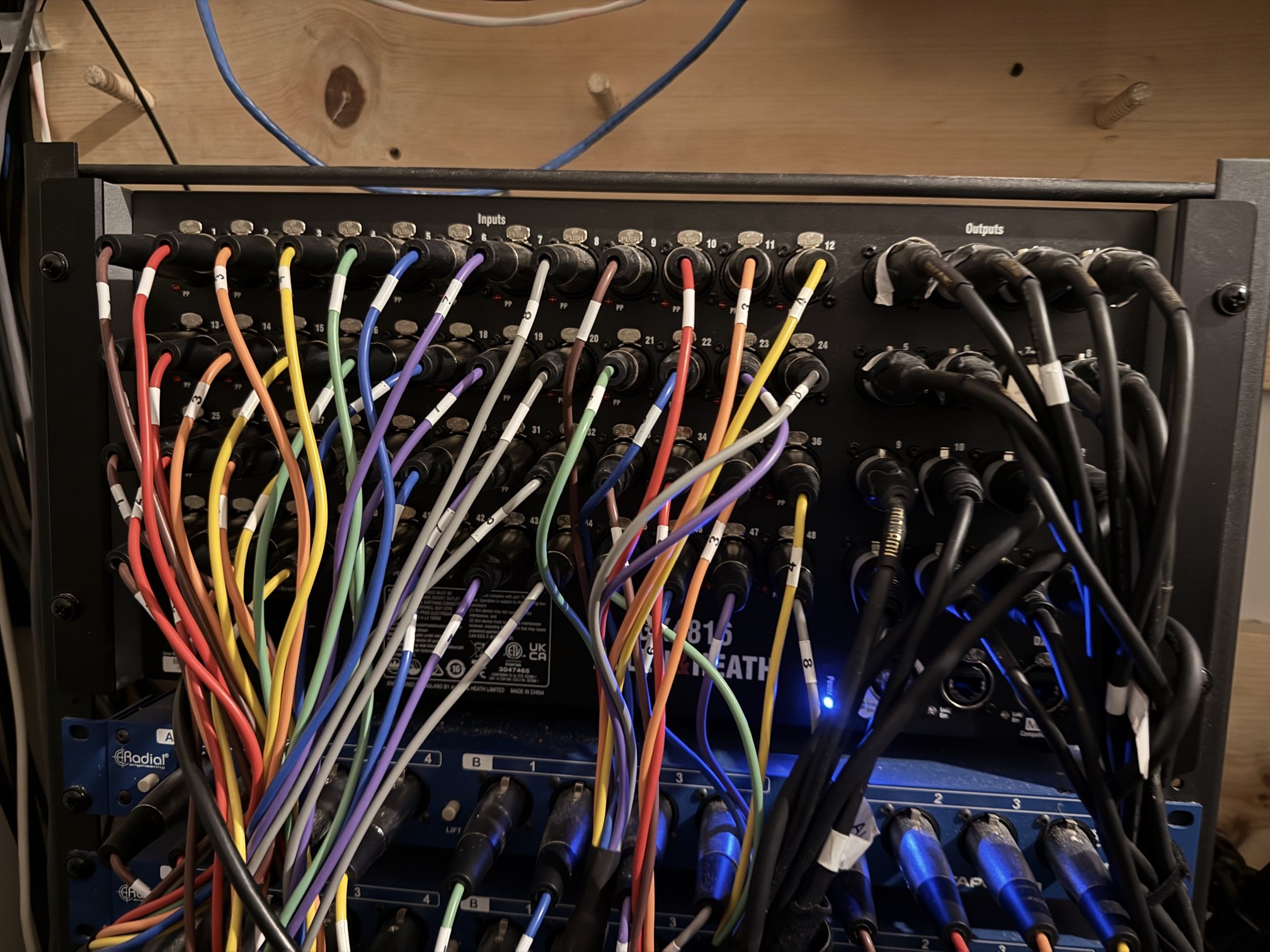
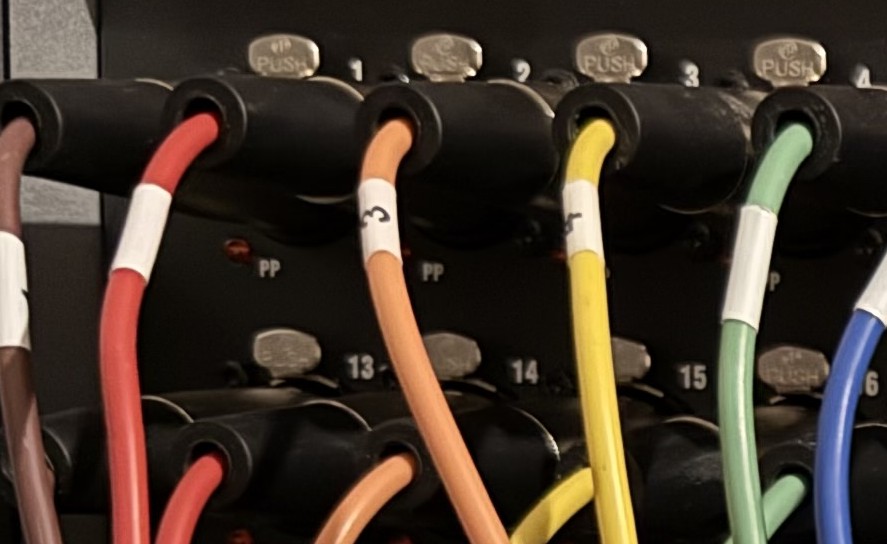
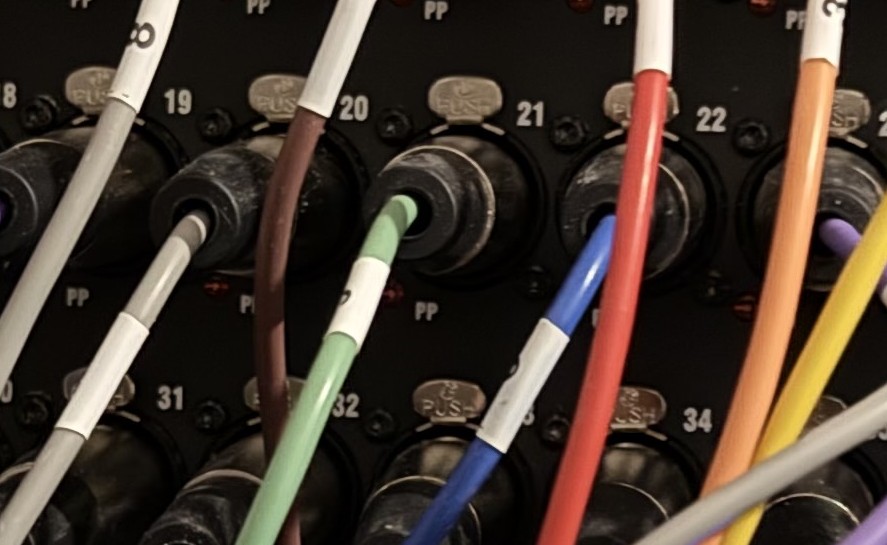
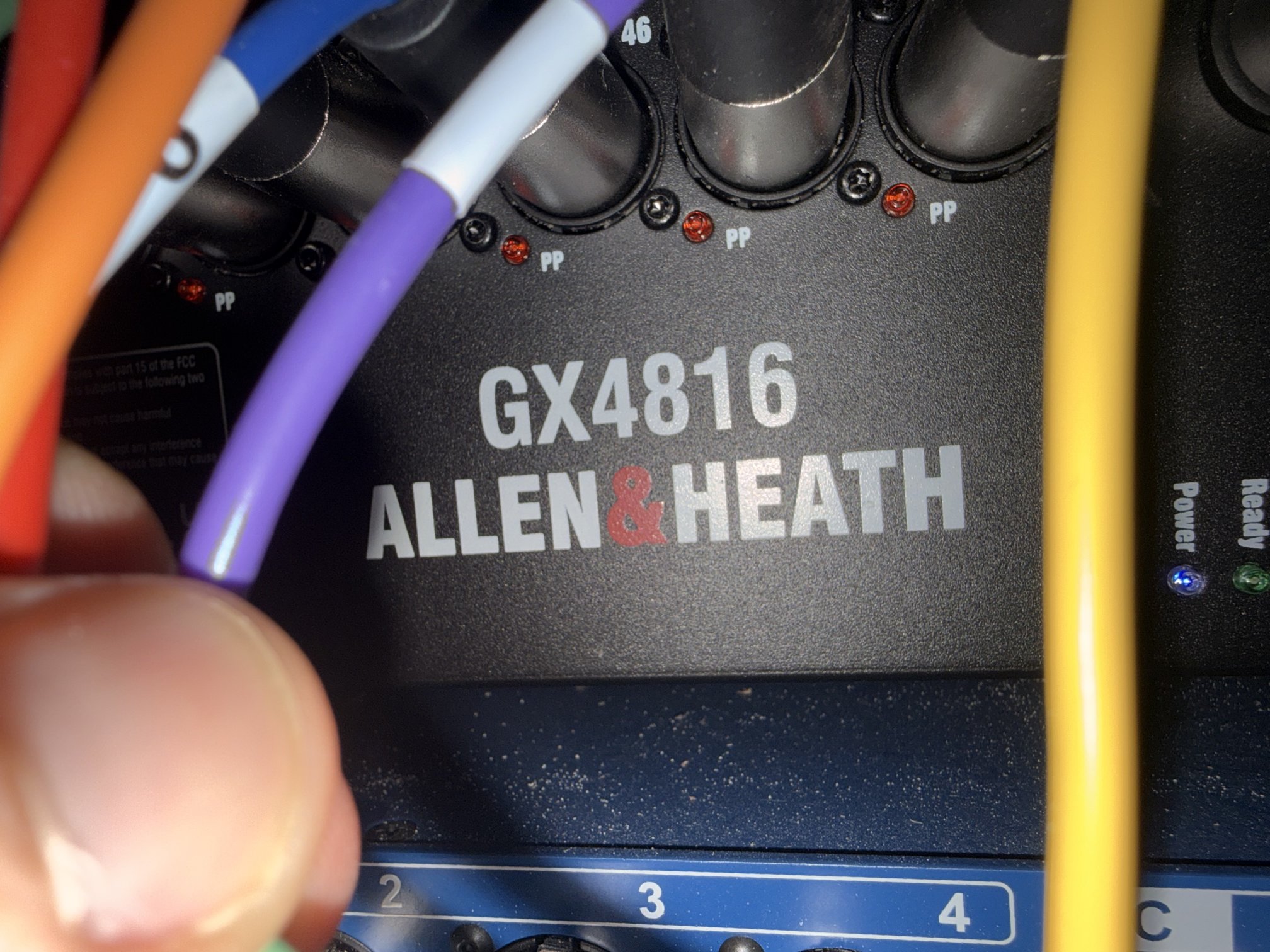
📷 Tonight's photos of the GX4816 and mic-closet Catapults


📚 v1 record from the evening: the 33 tests, reversals, questions for Elijah
🔌 The buzz lives on the mic-closet leg; the Trident leg tests clean
- 🔍 Two legs from one split. The mix-room Catapult feeds the Trident and, over Cat6, the mic-closet Catapult and the GX4816.
- 🔍 The Catapult is passive. One twisted pair per channel, pin 1 on the Cat6 shield. The ground lift only lifts pin 1.
- 🔍 A GX input is never open. Even powered off, pins 2 and 3 reach the GX chassis through the 6.8 kΩ phantom resistors, RF caps and clamps.
- 🔍 Two grounds, one pair. The voltage between the rooms drives current down the pair. An imbalance on 2 and 20 turns it into buzz.
- 🔍 Monitoring point. Amps by the Trident, all monitors, solo master, Greg's iPhone Live Listen.
⏱️ 33 tests between 20:22 and 22:04 PDT ended at “I'm stumped”
T1 · 20:22Amps and monitors on, all monitors, solo masterch 2✕ buzz
“So, yeah, that's clear that that's bad.”
T2 · 20:29Pull the Ethernet at the back of the mic-closet Catapultch 2▼ gone when removed
“if you unplug channel two here, that stopped it. / Completely? Completely. No buzz.”
T3 · 20:30Pull a second item on the ch 2 path into the GX (not named)ch 2▼ gone when removed
“That also stopped it.”
T4 · 20:30Pull the SLink Ethernet, GX to SQ-7ch 2? unclear
“That did not stop it when I unplugged that. / That did stop it.”
T5 · 20:31SQ-7 powered offch 2✕ buzz
“This is off, and that didn't take it up.”
T6 · 20:31GX4816 power removed entirelych 2✕ buzz
“To power out entirely, the buzz is still there. But if I take this out, the buzz goes away.”
T7 · 20:32Check whether GX aux outputs hit ch 2ch -- n/a
“These are auxes. So these are for PAs and in ears and monitors.”
T8 · 20:33Swap the XLR patch, Catapult to GX ch 2, for another mic cablech 2✕ buzz
“It's still there. Still buzz? Yeah. So it's not this cable.”
T9 · 20:35Unplug GX aux output cables one at a timech 2✕ buzz
“none of them fully did it. Some of them had a minor effect on it, but it was an inconsistent effect.”
T10 · 20:37Same pull test on ch 20ch 20▼ gone when removed
“Does it still go away? Makes it go away.”
T11 · 20:39Pull a patch: wrong one first, then ch 2. Hiss and buzz heardch 2▼ gone when removed
“There's a hiss and a buzz. When I take this out, the buzz goes away.”
T12 · 20:39Plug the ch 2 patch back inch 2✕ buzz
“Because I've plugged that back in and now it's there.”
T13 · 20:40GX off and SLink out togetherch 2✕ buzz
“Which means it's neither the connection to the SQ7 nor the power.”
T14 · 20:41Touch the box and connectorsch 2✕ buzz
“Still there? It's still there.”
T15 · 20:43Move the Ethernet between Catapult ports so the channels changech 2? unclear
“That did fix it ... that actually would mean that it is the Ethernet.”
T16 · 20:46First Ethernet tester on several cables: pin readings jump aroundch -? unclear
“this tester must be busted”
T17 · 21:05Plan an end-to-end loop test with a couplerch -- n/a
“We just need a coupler, and we need to get a long Ethernet cable around back around in the loop”
T18 · 21:06Second tester on the original Cat6ch -✓ clean
“I'm getting green on all of them. So, the Ethernet's okay.”
T19 · 21:11Unplug GX inputs 1 and 3 to 8, keep 2ch 2✕ buzz
“try three 4, 5, 6, 7, 8. Okay, so no.”
T20 · 21:14Unplug the rest of the GX one by one, power, SQ-7 offch 2✕ buzz
“The only thing is this and this and the Ethernet.”
T21 · 21:17Inspect the rack; buzz louder with Greg's body closech 2✕ buzz
“it's worse when I'm here. I hear like a big buzz there.”
T22 · 21:20Proposed snake cable test, declined as donech -- n/a
“we did test a different XLR. It was doing the same thing.”
T23 · 21:21Ch 20 pull test repeatedch 20▼ gone when removed
“Yeah, 20 does the same.”
T24 · 21:24Ch 20: Ethernet out vs XLR outch 20▼ gone when removed
“Just taking the Ethernet cable out cuts the buzz entirely ... Taking out channel 20 ... Very late [light] buzz”
T25 · 21:26SQ-7 on, SLink Ethernet outch 2✕ buzz
“when we unplugged the S-Link stuff, that Ethernet, it didn't cut the buzz.”
T26 · 21:27Phantom power on ch 2 switched offch 2? unclear
“Oh, that's cut that off, phantom.”
T27 · 21:27Compare 2 and 20; lower gain on 20ch 20✕ buzz
“This actually has less gain. Did that do anything? No.”
T28 · 21:35Source straight into GX ch 2, Catapult bypassedch 2✓ clean
“direct into this into that into there, clean.”
T29 · 21:43Find and run the unused silver Cat6 between Catapultsch 2- n/a
“Okay, it's plugged in.”
T30 · 21:51Listen through the new cablech 2 / 1✕ buzz
“Clean. / Oh, it's not Clean. ... What about channel one? Very clean.”
T31 · 21:52Reasoning on the new cablech 2✕ buzz
“that would be too random for that to cause the same problem on the same channel.”
T32 · 21:59Pull the new Ethernetch 2▼ gone when removed
“Did you did this cable fix it? Oh, no.”
T33 · 22:04Plan: everything electrical off, original Ethernet back inch 2· not tested
“turn just turn everything off and see if the buzz goes away.”
📋 Reported before Greg arrived: P0 to P15
P0 · Since installBuzz present since the beginning of the installation✕ buzz
Reported to Greg on arrival, not witnessed tonight.
P1 · Last weekMix room and Trident tested alone by Elijah with Oliver✓ clean
Reported to Greg on arrival, not witnessed tonight.
P2 · Before 20:04Two-hour routing test in the Live Room with Thomas; details inaudible? unclear
Reported to Greg on arrival, not witnessed tonight.
P3 · Before 20:14Two DPA snakes, new and installed, Catapult to Trident✓ clean
Reported to Greg on arrival, not witnessed tonight.
P4 · Before 20:14SM57 on Mogami into Catapult out ch 2, into Trident✓ clean
Reported to Greg on arrival, not witnessed tonight.
P5 · Before 20:14Panel to Catapult to Trident✓ clean
Reported to Greg on arrival, not witnessed tonight.
P6 · Before 20:14Mic into panel, Catapult bypassed, into a QSC✓ clean
Reported to Greg on arrival, not witnessed tonight.
P7 · Before 20:14Straight into the SQ-7 / GX, Catapult bypassed✓ clean
Reported to Greg on arrival, not witnessed tonight.
P8 · Before 20:14No microphone connected✕ buzz
Reported to Greg on arrival, not witnessed tonight.
P9 · Before 20:14Ethernet between the two Catapults unplugged▼ gone when removed
Reported to Greg on arrival, not witnessed tonight.
P10 · Before 20:14Catapult ground lifts pushed in✕ buzz
Reported to Greg on arrival, not witnessed tonight.
P11 · Before 20:14Channel survey: 2 and 20 bad, 16 cleanest✕ buzz
Reported to Greg on arrival, not witnessed tonight.
P12 · Before 20:14Route comparison: 1 and 16 clean, 2 and 20 dirty✕ buzz
Reported to Greg on arrival, not witnessed tonight.
P13 · Before 20:14Speaker directly on an A&H channel (connection point unknown)✕ buzz
Reported to Greg on arrival, not witnessed tonight.
P14 · Before 20:14Mix-room Catapult out to a QSC✓ clean
Reported to Greg on arrival, not witnessed tonight.
P15 · Before 20:14Mic-closet Catapult out to a QSC at line level, A&H out of the path; Ethernet pulled✕ buzz
Reported to Greg on arrival, not witnessed tonight.
🔁 Eight calls flipped or fell apart within the evening
- 💬 Greg, 20:05: bad hand crimps, re-crimp the heads→🔁 21:06: original Cat6 all pins green (T18). 21:52: a new cable still buzzes
- 💬 Elijah, 20:37: “It's that Ethernet. It's the Cat 6.”→🔁 21:08: “So, the Ethernet's okay.”
- 💬 Greg, 20:39 to 20:42: “It's something about this in this box that is wrong.”→🔁 21:38: “Okay, then it's not the Allen and Heath.”
- 💬 Greg, 20:45: “that actually would mean that it is the Ethernet”→🔁 21:08: Ethernet okay on the second tester
- 💬 Greg, 21:32: A&H email, the only culprit is “these two specific channels on the Alan and Heath”→🔁 21:34: “that nullifies my hypothesis”
- 💬 Elijah, 21:40: “I think the catapult's clean”→🔁 Next line: “the catapult's dirty” (P15)
- 💬 Greg, earlier: no to a new Cat6 between Catapults→🔁 21:42: “I think you're right. We do need to try that.” It did not fix ch 2
- 💬 Greg, 21:34: bypass test clears the GX→🔁 Diagnosis: premature. It shows GX input 2 quiet with one ground, not with two
🧠 One mechanism explains all ten observations
| Observation | Why it fits |
|---|---|
| GX off, SLink out, SQ off, buzz stays | The passive phantom network still connects pins 2/3 to chassis |
| XLR into GX input 2 pulled, buzz gone | Removes the only chassis connection on that pair |
| Cat6 pulled, buzz gone | Removes the pair from the mic closet entirely |
| New Cat6 and new XLR, buzz stays | The imbalance is not in a cable |
| Direct into GX input 2, clean | A mic floats: no second ground, no common-mode drive |
| Catapult ground lift, no change | The lift breaks pin 1 only; the path is pins 2 and 3 |
| GX aux outputs change it | Every aux load is another grounded device shifting the GX chassis potential |
| Body near the rack makes it worse | An unbalanced node picks up electrostatic mains fields |
| Ch 20 XLR pulled leaves a residue | Ch 20 shares its Cat6 with three channels still tied to the GX |
| Catapult direct to QSC buzzes (P15) | A powered monitor is a second grounded device, like the GX |
- 📅 2026-01-22 and 2026-08-03Every orange IG outlet tested reads open ground; neutral-to-ground floats 30 to 60 V
- 📅 Documented wiringGX outputs feed the Crown amp on the Furman, PSM900 in-ears, and subs on their own outlets: the GX chassis stays tied to ground with its cord pulled
- 📅 ~2026-03-16Channels 2, 20 and 22 logged down / crossing; bypassing the Catapult cleared ch 2 then too
- 📅 2026-08-03Handoff: loud buzz when 48 V phantom is engaged, mostly on Live Room mic lines
- 📅 At installCrew pressed Catapult ground switches until it worked; lift positions never recorded
- 📅 DocumentedLights and audio share a panel; Lutron dimmers on control-room and iso-room track lights
- 📅 2026-09-12Trident ch 26 reported buzzing; not retested tonight. Trident Star Ground Link state unrecorded
🎯 GX input vs Catapult channel is a coin flip; the ground difference is near certain
⚠️ v1 ranking from 20:00 to 22:05. Superseded by the v3 line-up above.
C1 Imbalance inside GX4816 inputs 2 and 20
Confidence: moderateMatched phantom resistors; a hot-patch with phantom on or a static event takes one out. Phantom LEDs look lit on some inputs in rows 1 and 2
C2 Imbalance in the mic-closet Catapult, channels 2 / 20
Confidence: moderateSame symptom, different box. The swap test separates C1 from C2
C3 Ground potential difference drives every case
Confidence: highHigh that it exists, given the open IG ground. Bonding the IG bus to service ground lowers the whole floor
C4 Phantom from two consoles on one line
Confidence: low-moderate48 V pushed through the passive split into the other console's input network. Untested (T26 result missing)
C5 Split pair in the Cat6 termination
Confidence: lowExplains one channel but not surviving a full cable swap
C6 A specific noise load
Confidence: unknownLED drivers, dimmers, Lorex camera PoE switch, PA amps on the GX auxes, HVAC. The all-off test (T33) never ran
✅ v1 test list: seven short tests, now folded into the v3 tree
- D1Swap test⏱️ under 10 min
Mic-closet Catapult out 2 into GX input 1, Catapult out 1 into GX input 2. Repeat with 20 and 16
➜ Buzz follows GX input 2 = GX input is the asymmetric part. Buzz stays on Trident ch 2 = asymmetry is upstream in the Catapult path
Before (tonight) After the swap 👂 Buzz moves to Trident ch 1 = GX input 2 is the fault. Replacement or A&H repair is justified👂 Buzz stays on Trident ch 2 = the fault is upstream, in the Catapult path🔁 Then repeat with 20 and 16 - D2Second grounded device⏱️ under 10 min
Catapult out 2 into a known-good grounded input (QSC or a spare preamp) instead of the GX
➜ Buzz = Catapult / pair side. No buzz = GX input
- D3Meter the grounds⏱️ under 10 min
AC volts GX chassis to Trident chassis (long wire to the DMM), and between ground pins of the two racks' outlets, lights and HVAC on and off
➜ Above about 50 mV AC = a ground difference worth killing
- D4Temporary bond⏱️ under 10 min
Heavy wire (12 AWG) between the mic-closet rack and the Trident chassis
➜ Buzz drops = ground difference confirmed; RX4M modules in the mic closet end the loop, and the IG bus bond lowers the voltage building-wide
- D5Phantom audit⏱️ under 10 min
Read phantom on the Trident, SQ-7 and GX LEDs for 1, 2, 16, 20. Turn all four off and listen
➜ Shows whether C4 is in play
- D6All-off test (T33)⏱️ under 10 min
Original Cat6 in, buzz audible, kill circuits one at a time: lighting, HVAC, PA amps, camera / network switch
➜ The circuit that silences it names the noise source
- D7Isolate the split⏱️ under 10 min
Mic-level 1:1 isolation transformer on ch 2 between Catapult out and GX in (Radial TX4M/RX4M or an inline iso)
➜ Buzz gone = permanent fix: transformer-isolated modules in the mic closet
❓ Ten questions for Greg and Elijah close the gaps
Type answers here, tap Copy, then paste them in the pane or a text. Nothing is sent from this page; drafts stay in this browser only.